

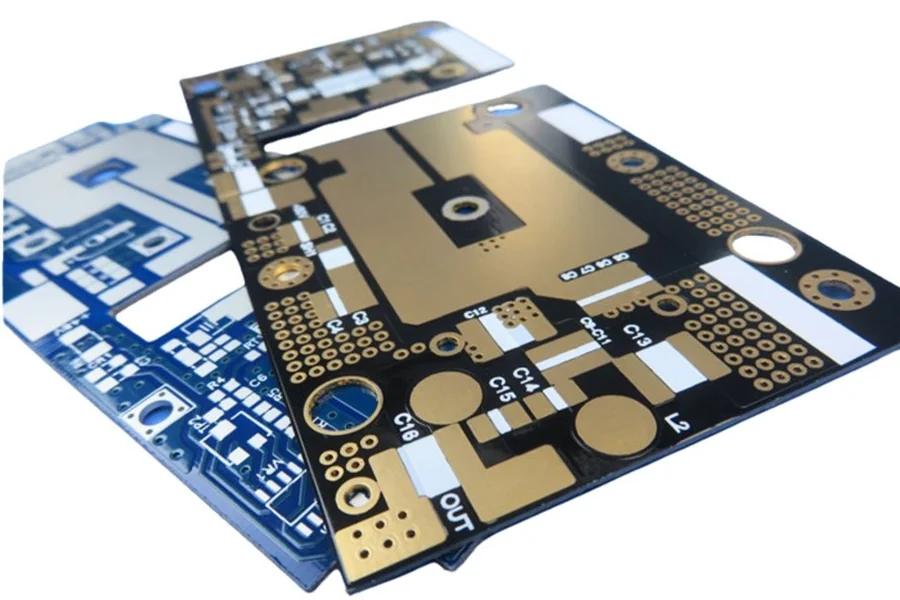
A PTFE PCB board is a specialized type of printed circuit board made from polytetrafluoroethylene, a synthetic fluoropolymer that is well-known for its exceptional electrical, thermal, and mechanical properties. Unlike standard FR4 boards, PTFE PCB boards offer superior performance in high-frequency and high-speed applications. Their low dielectric constant and minimal signal loss make them the preferred choice in industries such as aerospace, telecommunications, radar systems, and advanced medical devices. PTFE material, commonly recognized under the brand name Teflon, is chemically inert and highly resistant to temperature fluctuations, ensuring long-term reliability in demanding environments.
Properties and Advantages of PTFE PCB Board
One of the most important features of a PTFE PCB board is its extremely low dielectric constant, which allows signals to travel faster with minimal distortion. This characteristic is especially critical in microwave and RF circuits where maintaining signal integrity is paramount. PTFE material also has an exceptionally low dissipation factor, meaning it reduces signal loss even at very high frequencies.
Thermal stability is another strong advantage. PTFE can operate across a wide temperature range without degrading, making it ideal for applications where heat generation is unavoidable. The material’s non-stick and moisture-resistant nature also protects the board from humidity and chemical exposure, significantly extending its lifespan. In addition, PTFE PCB boards exhibit outstanding mechanical flexibility, allowing them to be designed in various configurations for complex systems.
Manufacturing Process of PTFE PCB Board
The manufacturing of a PTFE PCB board requires specialized techniques and equipment due to the unique characteristics of the material. PTFE is softer and more flexible than other PCB substrates, so it often needs to be reinforced with fillers like glass fibers or ceramics to improve dimensional stability. Once the substrate is prepared, copper foil is laminated onto the PTFE material through a high-temperature, high-pressure bonding process to ensure a strong adhesion without compromising its electrical performance.
Drilling and plating PTFE PCB boards also require careful handling, as the material can deform under excessive mechanical stress. Manufacturers typically use precision drilling machines and controlled plating methods to create accurate vias and conductive pathways. To achieve the highest quality, advanced etching techniques are employed to define intricate circuit patterns while maintaining the integrity of the PTFE substrate.
Applications of PTFE PCB Board
PTFE PCB boards are widely used in applications where speed, accuracy, and reliability are essential. In telecommunications, they are used in base station antennas, microwave links, and high-speed data transmission systems. Aerospace engineers rely on PTFE boards for radar modules, navigation equipment, and satellite communication systems due to their excellent signal integrity and resilience in extreme environments.
The medical industry benefits from PTFE PCB boards in imaging devices, laser systems, and diagnostic equipment where precise signal control is necessary. In the automotive sector, especially in electric and hybrid vehicles, PTFE boards are employed for advanced driver-assistance systems (ADAS) and vehicle radar applications. These boards are also used in high-frequency test equipment, ensuring accurate measurements in R&D and manufacturing processes.
Comparison with Other PCB Materials
When compared to FR4 and ceramic boards, PTFE PCB boards excel in applications requiring minimal signal loss at high frequencies. While FR4 is cost-effective and widely available, it cannot match the dielectric performance of PTFE, especially above gigahertz frequencies. Ceramic boards, on the other hand, offer excellent thermal conductivity but are less flexible and more brittle than PTFE substrates.
PTFE PCB boards strike a balance between high-frequency electrical performance and mechanical adaptability. This combination makes them the go-to choice for engineers designing systems where both precision and resilience are necessary. Although PTFE boards can be more expensive and challenging to manufacture, their benefits in performance-critical applications justify the investment.
Future Outlook for PTFE PCB Board Technology
As industries push toward faster communication networks, more efficient radar systems, and increasingly compact high-performance electronics, the demand for PTFE PCB boards is expected to grow significantly. Advancements in material science are leading to PTFE composites with even better dimensional stability, improved heat resistance, and reduced production costs.
With the expansion of 5G technology, Internet of Things (IoT) devices, and aerospace innovations, PTFE PCB boards will continue to play a pivotal role in enabling reliable, high-speed, and high-frequency signal transmission. Manufacturers are also focusing on refining production techniques to achieve tighter tolerances and more complex multilayer designs without compromising the unique advantages of PTFE material.
Choosing the Right PTFE PCB Board Manufacturer
Selecting the right PTFE PCB board manufacturer is critical to ensuring the highest quality and performance of your final product. The ideal manufacturer should have expertise in handling PTFE materials, advanced equipment for precision manufacturing, and a proven track record in producing boards for high-frequency applications. From material selection to prototyping and mass production, partnering with an experienced manufacturer guarantees optimal results. A professional PTFE PCB board manufacturer will not only deliver a product that meets stringent industry standards but also provide valuable insights into design optimization, ensuring your project achieves its performance goals.
